
COVER STORY
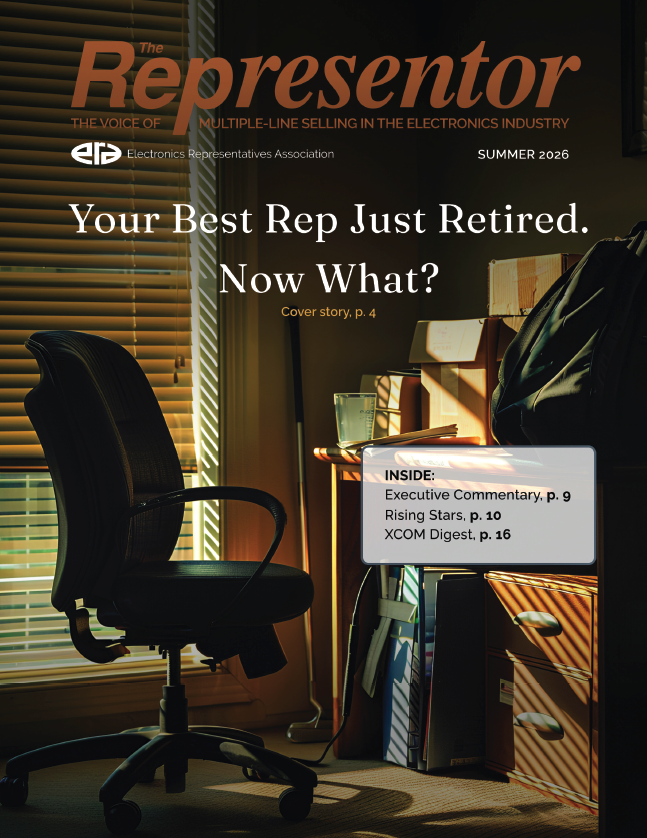
Your Best Sales Rep Just Retired. Now What?
By John Mitchell, Founder, Repfabric
Every electronic rep firm has one.
The salesperson who’s covered the same distributors, OEMs and key accounts for 20 or 30 years. They know which contacts actually drive decisions and which ones slow things down. They know which opportunities are real and which ones will never move forward. They remember every design win, every lost socket and every project that slipped away to a competitor. And when they retire, all of that knowledge leaves with them.
The electronic components rep channel is running straight into this challenge. An aging sales workforce, specialized product lines and long project lifecycles are all converging. Replacing the person is tough. Replacing what they knew is the real problem.
The stakes are higher than they look
In the electronic rep world, relationships and context drive everything.
A rep isn’t just selling components. They’re managing trust between manufacturers and distributors, while working with engineering, purchasing and program teams. That trust takes years to build and can fade quickly when a familiar face disappears, and a new one shows up without context. Timing only increases the pressure.
A new rep who doesn’t understand where a project stands can easily miss an opportunity. They might spend time chasing something that’s already been lost, or overlook a program that’s about to move into production because they didn’t know the history.
That’s not just a small miss. That’s revenue tied to an entire product lifecycle. And across the industry, firms are seeing the same issue: the most valuable knowledge in the business isn’t captured anywhere; it’s sitting in someone’s head.
Why knowledge doesn’t transfer on its own
Most firms try to tackle this with overlap time, ride-alongs or asking reps to document their accounts before they leave.
But in practice, that rarely works the way people hope. Veteran reps are busy right up until the end. Their knowledge isn’t organized in a clean, transferable way; it’s built from years of conversations, emails and instinct. Even when they try to document things, what gets written down is often high-level, missing the nuance that actually drives decisions.
Ride-alongs help, but they only capture a snapshot. They don’t recreate the history behind a stalled program or the context behind a long-standing relationship.
And once the rep is gone, the new person is left piecing things together from scattered notes, inbox threads and whatever they can gather from distributors or customers.
The issue is not a lack of effort; it’s a lack of structure. Most organizations rely on individuals to carry context in their heads instead of building a consistent way to capture it as work happens. Without that structure, even well-intentioned handoffs fall apart under the pressure of day-to-day selling.
Building a system that captures as it goes
The strongest firms don’t wait for transition moments. They capture knowledge continuously. They treat account intelligence as a shared asset, not something owned by one rep.
That means going beyond contact lists and open opportunities. It includes tracking project history, key relationships, competitive dynamics and why deals were won or lost. More importantly, that information gets captured as part of the normal workflow, not as an extra task that gets skipped when things get busy.
When a rep logs a customer visit, updates an opportunity, or follows up on a program, those actions create a permanent, searchable record tied to the account and the product lines involved. Over time, that builds a living history the entire team can rely on.
Where technology (and AI) changes the equation
This is where modern tools are starting to close the gap. Instead of asking reps to sit down and document everything after the fact, today’s platforms allow information to be captured in the moment. A rep can dictate a call summary right after a meeting, and the system organizes and files it automatically.
What used to require disciplined manual entry at the end of the day can now happen in a couple of minutes between meetings. That reduction in friction matters. It’s the difference between a system that gets used consistently and one that gets abandoned as soon as things get busy.
Managing multi-line complexity
For most rep firms, this challenge is even more complex because they manage multiple manufacturers across the same accounts. The context behind one product line can’t bleed into another. Conversations, opportunities and strategy need to stay organized by line without creating more work for the rep.
Firms that handle this well have a clear, structured way to keep activities separated while still giving leadership a full picture of what’s happening across the territory. Without that structure, information either gets siloed, or worse, lost entirely.
What the next rep inherits
When a territory changes hands, the real question is what the next rep walks into. If knowledge hasn’t been captured, they’re starting from zero. Rebuilding relationships, rediscovering opportunities and repeating mistakes that have already been made.
But when activity and context have been captured consistently, the starting point looks very different. A new rep can open an account and see the full history: conversations, opportunities, past wins and losses and the current state of each program. They understand where things stand before they ever make a call.
It’s not a substitute for experience, but it dramatically shortens the learning curve. Managers benefit too. When activity is visible, they can see which accounts are being covered well, which ones are going quiet and where the real opportunities are building. That turns knowledge from something reactive into something that can actually be managed.
It’s not just about retirement
While retirement is often the trigger, this problem shows up any time a territory changes hands.
Growth, reorganization and turnover all create the same risk. The difference is that most firms only feel the full impact when someone with decades of experience leaves. By then, it’s already too late to recover everything that was lost.
The bottom line
The electronic components industry has always been relationship-driven. That’s not changing. But the way firms preserve and share what those relationships represent has to evolve. Because the real risk isn’t losing a salesperson. It’s losing everything they knew.
If your organization has not yet taken a hard look at how dealer and account intelligence is being captured and protected, do not wait for the next retirement announcement to find out what you stand to lose. Start closing the gap now.
About the Author
John Mitchell is the founder of Repfabric, a CRM and commission management platform built specifically for manufacturers’ representatives and the multi-line sales channel. A former rep himself, Mitchell created Repfabric to solve the operational and data challenges he experienced firsthand running his own agency. For more information, visit repfabric.com.