
> ERA Quick Connections — Nov. 2023, Vol. 2

November 2023, Volume 2
MONTHLY POS REPORTS

Our base point of January 2021 saw the COVID-19 pandemic beginning to lose steam, resulting in a significant rebound in POS activity. Due to strong growth in 2022, there is the good probability that we will see a slowdown of POS activity in 2023. Outside influences will also affect 2023, including supply chain issues and inflation.
September 2023 was up 3.5 percent from August, making it the second largest POS month for the year. This year is running 3.5 percent behind last year’s record year, but POS activity for 2023 is still holding its own on an overall basis. September is typically a strong month and this September did not disappoint. In general, 2023 POS is continuing to exhibit above average activity.
DTAM information is available for anyone wishing to look at larger trends in the industry. For details on Budde Marketing’s services, visit BuddeMarketing.com.
INDUSTRY NEWS
> The U.S.-China chip war and what it means for you, from EPS News. Read more.
> Amazon cuts Alexa jobs in order to focus more on generative AI. Read more.
> The semiconductor market’s outlook is brightening, reports Supply Chain Connect. Read more.
INDUSTRY TRENDS SURVEY

The November ERA Industry Trends survey is now closed.
Be on the lookout for the December survey in your inbox on Dec. 1!
Please note: ERA sends this survey monthly to one contact from each ERA member firm via email. Please be on the lookout for this survey in your email inbox. If you don’t see it, check all email folders, including spam. The email will come from no-reply@mail.client.
If you have been completing the survey monthly, many thanks! Our survey is only made better by a robust and diverse universe of responding companies. Help us make this survey a valuable resource for you and the rest of our members by taking 5 minutes to complete this each month. The results are visible only to ERA members and gives us a great cross-section of what our members see on the horizon for the near and long term.
VIEW 2023 SURVEY RESULTS
ERA NEWS
> The next ERA LIVE on Nov. 28 will feature Alex Gabbi who will present the topic, “A Look at Our Industry Through the Eyes of Academia: What are University Students Being Taught?” Topics will include the challenges of finding, recruiting, onboarding and retaining young college graduates, and what current students are being taught as it relates to core technologies (AI). No registration needed — view more details and log-in information.
> If you did not have the chance to attend the live STEP 2023 event, but still want to access the event’s valuable educational content, the STEP 2023 recordings are now bundled and available for purchase. The STEP 2023 archive is available to ERA member individuals for $295 and to non-member individuals for $395. Happy learning!
> 2024 ERA Conference registration is nearly sold out! Want to secure your seat at the most popular industry event, and have the opportunity to network with more than 600 rep, manufacturer and distributor leaders? Do not wait. Register now! Show your support for this great event by becoming a sponsor.
FOR YOUR CALENDAR
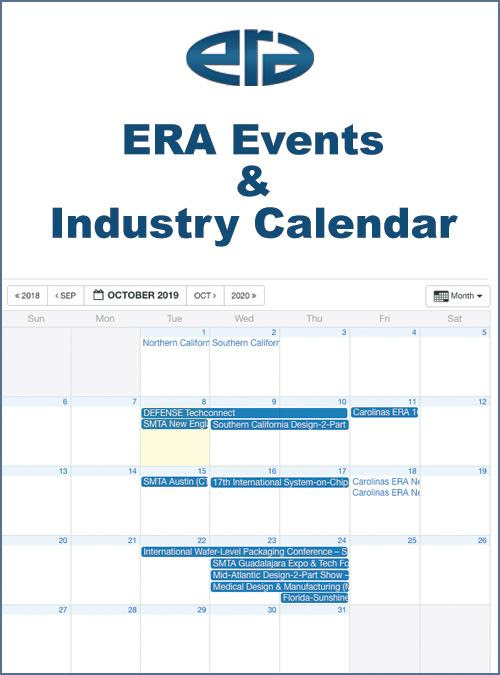
Browse the searchable ERA Industry Calendar for upcoming national and local chapter events!
Follow Us!


|
|
|
|


Posted in: Press Releases
Leave a Comment (0) →


 > The Fall


 The Electronics Representatives Association announces the latest graduates of its 2023 Chapter Officer Leadership Training (


 > COLT — ERA’s live, virtual chapter officer leadership training program — will take place Nov. 1-3, and registration will end tomorrow, October 25! Chapter officers, or those interested in pursuing a chapter leader role, are encouraged to attend and gain creative ideas and practical knowledge about increasing member engagement and excitement in their local ERA chapter.
 > 2024 ERA Conference registration is at 85 percent capacity for attendees! Want to secure your seat at the most popular industry event, and have the opportunity to network with more than 600 rep, manufacturer and distributor leaders? Do not wait.


 Manufacturing data reports from the Institute for Supply Management (ISM) are released at the beginning of every month and can be accessed at




> The hurrier I go – the behinder I get!
EXECUTIVE COMMENTARY
Walter Tobin, ERA CEO
by Walter E. Tobin, ERA CEO
This time a year ago, many of us were asking our partners (and were also asked by them), “How’s business?”
We then may have listed a litany of challenges that we were dealing with: long and uncertain lead times, unclear/inaccurate forecasts from our customers and being asked to adhere to and/or pass along NCNR clauses that had never seen before. There were shipping issues, port backups, the Great Resignation phenomenon, work-from-home issues, the search for the “golden screw”— so many things for us to consider and manage every day.
Yet, when a follow-up question was asked or we asked, “How’s your revenue this year?” we often said or heard, “We are having a record year!”
How was that even possible? I guess there must have been some product somewhere that was able to be shipped and billed to someone.
Was all of this product really needed? We have now become aware that there was a lot of double/triple ordering done to hedge our bets on averting product shortages. We may have agreed to NCNR clauses that we would have never even considered to agree to in the past, all while hoping that our own “golden screws” arrived on our docks.
So here we are a year later. Lead times have returned to a more normal cadence and many golden screws have been received. The NCNR clauses that we agreed to are now being enforced, all leading to a period of declining bookings with book-to-bill ratios falling below 1:1. We are now relying on our past order backlog to sustain us.
Bookings down, billings falling, inventory rising…yikes! What are we do to now? Some companies have adopted a “damn the torpedoes: full speed ahead” policy: cancel open orders, refuse shipments on past orders placed and accepted in good faith, renege on NCNR orders and begin to sell excess inventory on the open/gray market. This is all to achieve some short-term relief and to try to maximize their own quarterly/annual financials. Some of these tactics are working!
Some companies are demanding lower prices due to the return of a “buyer’s market” and to take advantage of companies who are now swimming (drowning?) in inventory. These companies are under pressure to reduce their own inventories and sell at reduced prices that will then lead to their own lower margins, which will then wreak havoc on their own financials.
In addition when companies sell their excess inventory to the gray market, it sits out there only to be sold down the road to customers who may take advantage of lower prices who may have bought this product from the authorized manufacturer/distributor channel who were relying on new orders down the road to help them sell their inventory. This excess inventory sits out there and then is sold down the road at lower prices —another short-term action that has longer-term ramifications on our supply chain.
When COVID-19 hit and the supply chain “broke,” why did it break? Because no one had any “upside” inventory to support the need for unforecasted demand inside of lead time. Customers were clamoring for manufacturers to simply “turn on” or build factories to support this unforecasted demand and many were asking as to why the distributors did not have more product on their shelves.
We will never learn, will we? But here we are again, looking to take margin away from the company to our left and right in the supply chain and to demand lower prices which then limits their ability to fund unforecasted inventory in the supply chain.
We need to try to take the long-term approach. It doesn’t help that Wall Street forces public companies to look at business on a 90-day horizon which forces public companies to do the yin and yang every 90 days. Wall Street also forces our publicly traded suppliers and channel partners to fight each other while customers are looking to us to right the ship, all while demanding lower prices.
A new and perhaps naive approach is for each one of us to ask the company above and below us in the supply chain for their help and guidance on preventing the supply chain disaster of the COVID-19 period from happening again. Ask, “What do you need from us?” Perhaps allow them to make a bit more margin on our business to then help fund new factories, unforecasted demand and shorter lead times. Build a true partnership based on mutual respect and trust, and not just on price alone.
Try it on one of your supply chain partnerships and see what they say. What harm can it do? You may end up positioning your company ahead of the rest of your competitors when times get tough again. It’s worth a try!
Posted in: Commentary
Leave a Comment (0) →